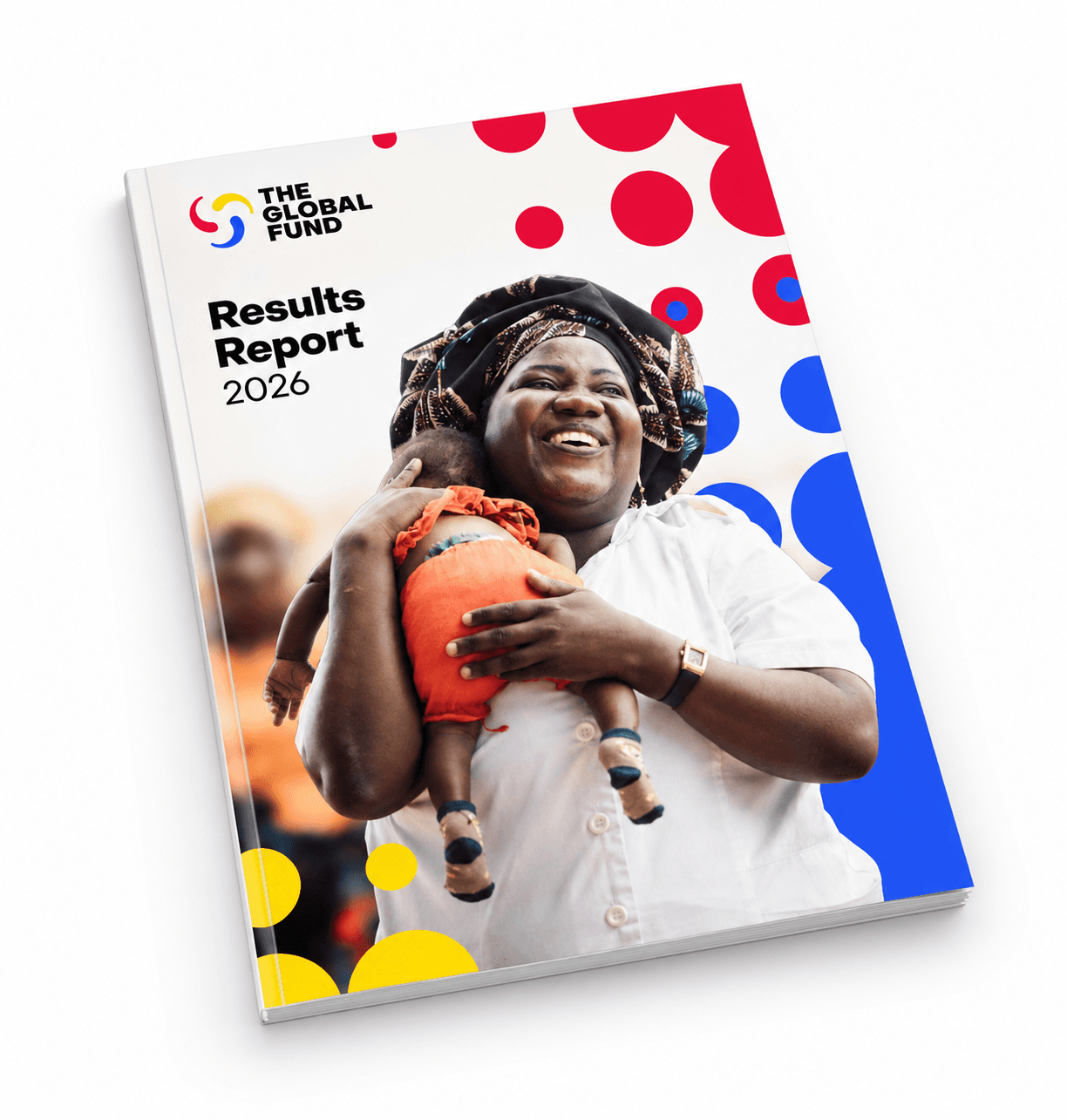
The Global Fund to Fight AIDS, Tuberculosis and Malaria’s report reviews 2025. It highlights the resilience of programs in the face of unprecedented budget cuts. Here is what it says about the MENA region.
A region accounting for 2% of the investment portfolio
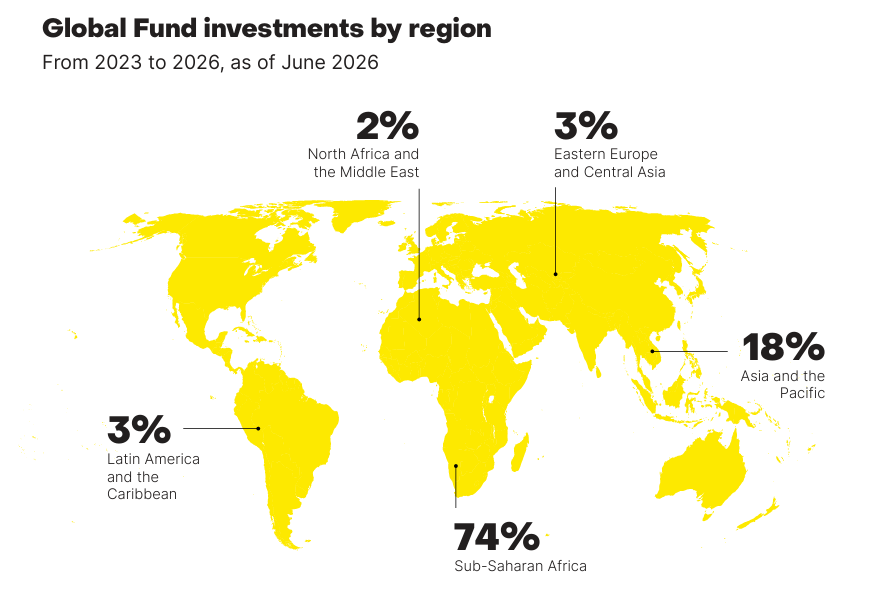
Global Fund Results Report 2026, p. 87
Over the 2023–2026 period, the Middle East and North Africa region accounts for 2% of the Global Fund’s global investment portfolio, far behind Sub-Saharan Africa (74%) and Asia-Pacific (18%), and slightly below Eastern Europe and Central Asia and Latin America and the Caribbean (3% each). This allocation pattern places the MENA region at the lowest level among the major geographic regions covered by Global Fund grants.
MENA countries cited in emergency funding
In the chapters on the three diseases (HIV, tuberculosis, malaria), the MENA region appears mainly in connection with emergency interventions and targeted support, rather than as part of long-term, sustainable development pathways or clearly structured results :
- HIV/AIDS: 2025–2026 emergency funding deployed to support the response in humanitarian crisis settings in Iraq and Lebanon (alongside Botswana, Cuba, Myanmar and Venezuela).
- Tuberculosis: 2025–2026 emergency allocations aimed at maintaining essential services in Iraq, Lebanon and Sudan (alongside Botswana and Myanmar).
- Resilient and Sustainable Systems for Health (RSSH) : Technical assistance in Sudan redirected to support the response to an acute crisis.
Unlike other areas such as Sub-Saharan Africa or South-East Asia, the MENA region is not the subject of any case study or in-depth data series in the “Results” or “Investing for Sustainable Impact” sections. It is thus identified primarily as an area of fragility managed through crisis responses, without being linked to a clearly documented trajectory of sustainable impact.
Malaria in Sudan: +332% in deaths between 2010 and 2024
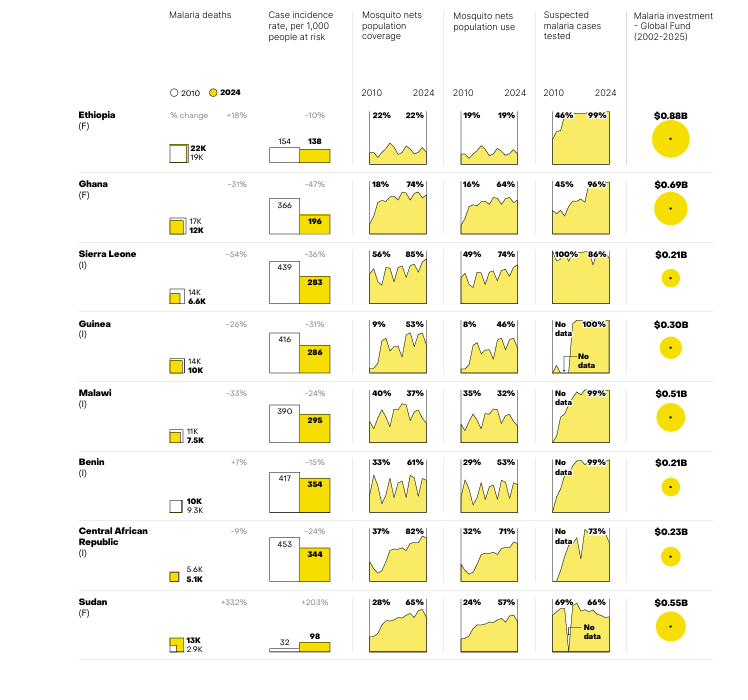
Excerpt from the 2010–2024 malaria summary table. Sudan is among the few countries showing a significant increase in mortality and incidence. Source: Results Report 2026, p. 57
The country table in the malaria chapter reveals a severe deterioration in the health situation in Sudan between 2010 and 2024, marked by sharp increases in key indicators :
+332% in malaria-related deaths
+203% in the incidence rate
While almost all of the 32 other countries analyzed recorded double-digit declines, only Niger and Tanzania also show an increase, and to a much more limited extent.
The report links these trends in Sudan, Yemen and the Sahel to weakened epidemiological surveillance, disrupted supply chains and the impact of conflict. Sudan thus illustrates how the erosion of health structures can undo two decades of progress against the disease within just a few years.
Missing data for Djibouti
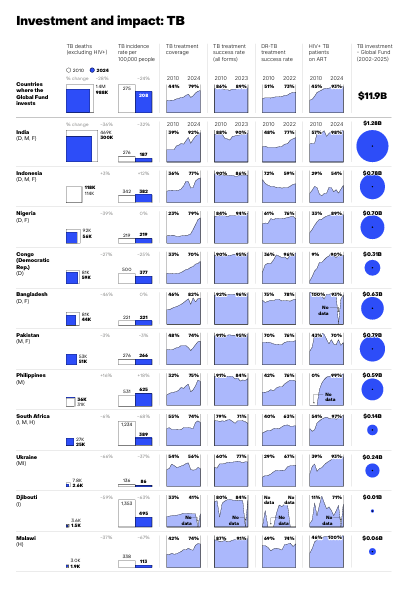
In the summary table of the tuberculosis chapter, Djibouti is the only MENA country with structured comparative reporting alongside other countries. However, a closer analysis of the data reveals significant gaps in performance monitoring. The entry “No data” appears for two major epidemiological and clinical indicators :
- The treatment success rate for multidrug-resistant tuberculosis (MDR-TB);
- The rate of antiretroviral therapy (ART) initiation among HIV/TB co-infected patients.
The absence of these key indicators is particularly striking given that these data are reported for nearly all other countries in the same table. This documentation gap for Djibouti reflects persistent challenges in collecting and reporting evidence-based data in the region, hindering an accurate assessment of continuity of care and of the response to complex co-infections.
Grant Cycle 8 : between self-reliance and crisis settings
The report devotes a major forward-looking section to supporting countries on their path toward self-reliance as part of preparations for Grant Cycle 8 (GC8, 2027–2029). This roadmap is built around three financial and strategic pillars :
- Strengthening domestic co-financing: Stricter requirements for domestic budget commitments, which may reach up to 35% of the total allocation depending on the country;
- Predictable transitions: Rolling out gradual, modeled pathways for transitioning out of grant support, to safeguard health gains over time;
- Mobilizing additional domestic resources: A global target of at least $1.4 billion in additional domestic investment over the 2027–2029 period.
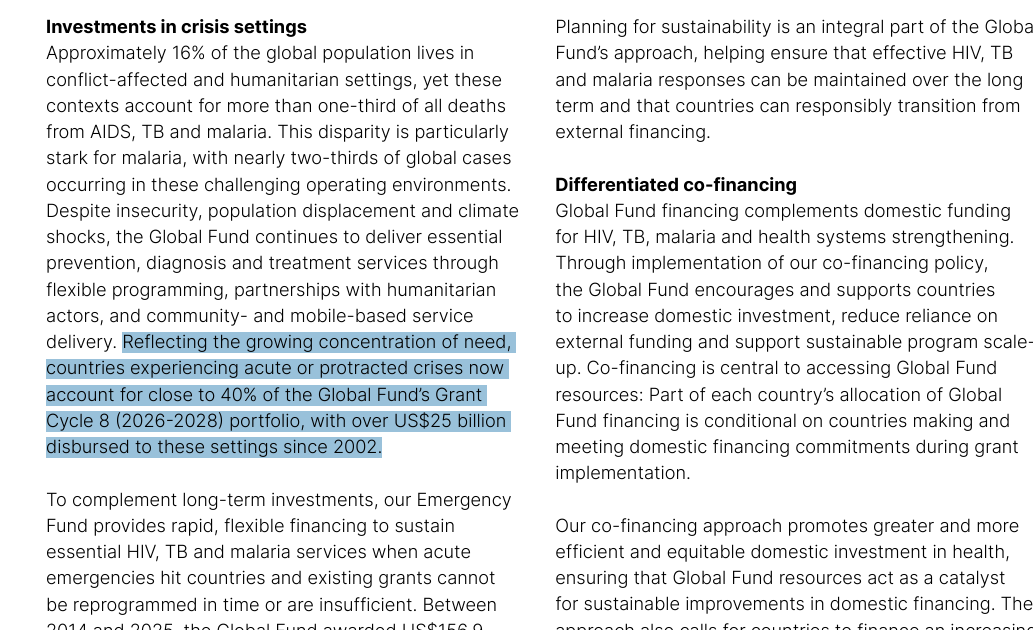
In the MENA region, this shift toward financial sustainability directly raises the question of states’ absorption capacity and their ability to take over funding through national budgets, particularly for countries facing mounting economic constraints and difficulties in accessing external financing.
At the same time, the report highlights the growing scale of needs in areas affected by crisis and instability. These fragile or conflict-affected settings – which include several priority countries in the MENA region (Sudan, Yemen, Syria, Lebanon) – account globally for 16% of the population, more than one-third of deaths from the three diseases and up to 63% of malaria cases. Reflecting this health vulnerability, these settings now account for nearly 40% of total GC8 investments.
Source: Global Fund, Results Report 2026 · Investment data as of June 2026